„What Could AI do for Women and Vice-Versa!”

„We see the natural process in the timeline of AI - from hype to correction to safety and privacy concerns. In the coming few months we will be seeing A LOT of fascinating updates in space!”
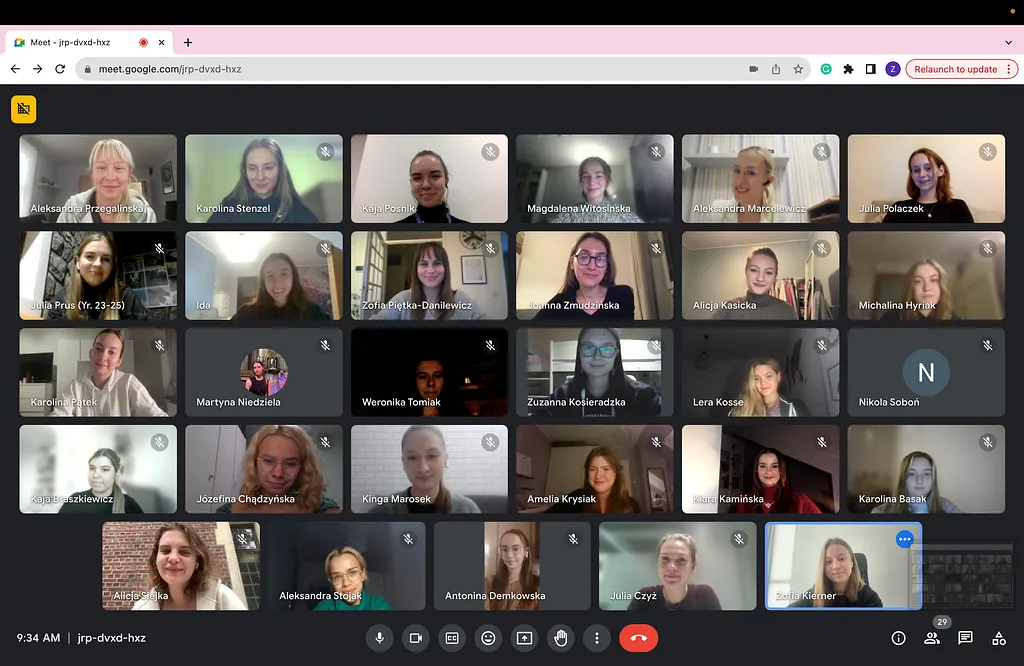
Aleksandra Przegalińska is an AI expert, a senior research associate at Harvard labor and work life program and an Associate Professor and Vice-President at Kozminski University, where she leads the Human-Machine Interaction Research Center. During the #HerStory Masterclass (a 1,5h workshop organized by the Girls Future Ready Foundation) she told us about AI - should we be afraid of it, what consequences it brings, as well as about the risks and opportunities. She touched on all the topics that will be useful to us, not only now, but also in the future. Here are my favorite lessons from Ola:
- AI is Supposed to Help and Support People at Work
Ola started our meeting by telling us about her perspective on AI:
“AI is not about creating general artificial intelligence. AI is important for humans when it is used to support and assist in work and education.”
Artificial Intelligence is at the forefront of technological innovation, revolutionizing the way people work and interact with the world. It’s potential to help and support people in the workplace is virtually unlimited. AI-powered tools streamline everyday tasks, increase productivity, and allow employees to focus on creative tasks. With advanced algorithms and machine learning, AI systems can analyze huge datasets in seconds, providing valuable information that help us to make informed decisions. In addition, AI-based automation optimizes workflows, reducing errors and increasing productivity across different industries. Artificial intelligence also plays a key role in education. AI-based systems cater to individual learning styles, fostering a more inclusive and effective learning environment. As technology advances, AI promises to transform workplaces into a smarter, more flexible, and supportive environment, enabling people to achieve new successes.
- Threats of Artificial Intelligence
The rapid development of artificial intelligence is relevant to a number of unavoidable threats, some of which have already begun to appear. One of the most pressing issues is the ability of AI to create confusing, voice-driven clones or interact with individuals in ways that can be quite disturbing. This raises worrying questions about the intentions of those who use this technology. Moreover, the immediate threat of disinformation is enormous, as artificial intelligence can be used to rapidly disseminate false information, undermining trust in societies. Looking ahead, the shift to responsive technology, where AI models act as agents in networks, is particularly worrisome. These models, locked in a box, may soon have the ability to perform complex tasks such as writing algorithms, conducting analytics, or compiling emails. The use of such “models” carries inherent risks. For example, AI can be used to automate recruitment processes, make decisions, browse applications, and send correspondence. Such changes raise deep ethical questions about agencies, accountability, and the potential misuse of AI, highlighting the urgent need for regulations and frameworks to navigate this highly complex system.
- Positives of Artificial Intelligence
The positive impact of AI extends across different fields, shaping the innovative future. In medicine, AI works with scientists and doctors to develop breakthrough therapies and develop new drugs, improving healthcare outcomes. AI not only helps discover treatments, but also improves patient admissions by modernizing hospital and healthcare systems. In education, language models based on artificial intelligence provide invaluable support by offering personalized feedback to many students during lectures - Ola also uses such a system. These models tailor teaching methods to individual learning styles, ultimately enhancing the learning experience. In addition, the positive impact of AI extends to logistics, industry, and agriculture, saving resources and improving overall productivity. Significantly, these advances also promote neurodiversity, creating inclusive environments where individuals with diverse cognitive abilities can develop. By harnessing the power of AI in these areas, society embraces a future that is not only technologically advanced but also deeply empathic, supporting a world where innovation and inclusion go hand in hand, enriching the lives of all people.
“Artificial Intelligence has just as many pros as cons. Through my day-to-day work with it, I see more positives, but I know that without AI education, it can be hard.”
Thank you, Ola, for this valuable #HerStory Masterclasse. The amount of future-oriented knowledge about life, education, and work in the age of AI has broadened our horizons and shifted our perspectives. Thanks to you, we can be even better prepared for our careers and become #futureready!
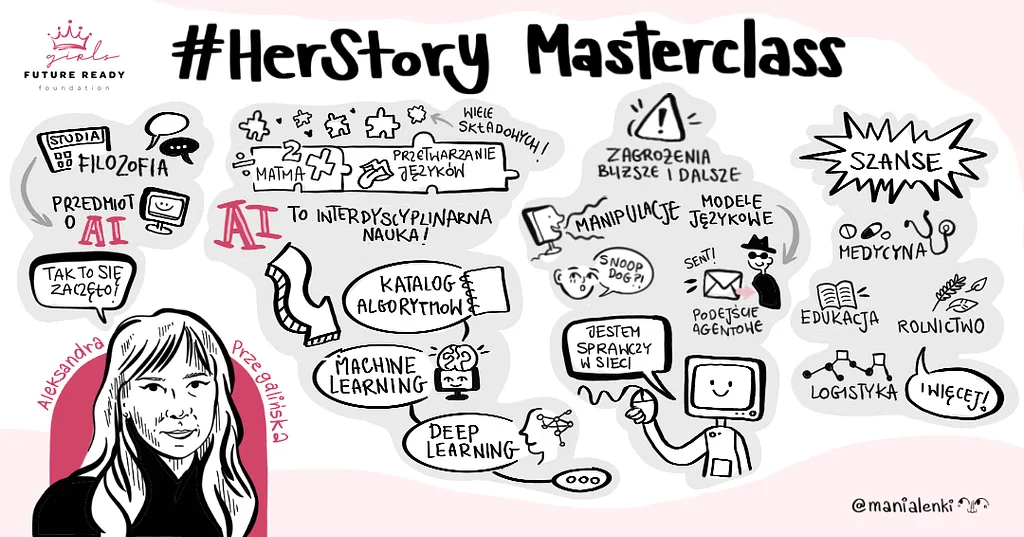
If you want to know even more about what happened that wonderful Wednesday evening, look at the graphic created by one of the laureates of the #HerStory Project - Magda Witosińska. Thank you, Magda, for your commitment again! We love watching you grow with Girls Future Ready!
Make sure to check out the @girlsfutureready instagram and follow for more inspiration!
By Weronika Wojnarowska and Girls Future Ready Foundation, 2023
First published on Medium